


Related search
Bar Accessories
Decorating Design
Keyboards
Kitchen Gadgets
Get more Insight with Accio
Open Claw Smart Grippers Transform Industrial Automation
Open Claw Smart Grippers Transform Industrial Automation
7min read·James·Mar 25, 2026
MIT researchers achieved a remarkable 90% success rate in object handling with their revolutionary reflex-based gripper system, marking a pivotal moment in smart gripper technology advancement. This breakthrough eliminates the traditional binary success-or-failure approach that has plagued industrial automation for decades. The MIT system completed 117 pick-and-place attempts with household objects ranging from rigid bowls to deformable coffee grounds, demonstrating unprecedented versatility in robotic manipulation advances.
Table of Content
- Smart Gripper Revolution: Why Adaptive Robotics Matter Now
- From Arcade Claws to Intelligent Manipulation Systems
- Smart Gripper Applications Transforming Supply Chains
- The Future is Already Here: Acting on the Gripper Opportunity
Want to explore more about Open Claw Smart Grippers Transform Industrial Automation? Try the ask below
Open Claw Smart Grippers Transform Industrial Automation
Smart Gripper Revolution: Why Adaptive Robotics Matter Now

The global robotics gripper market, valued at $3.2 billion as of 2025, is experiencing unprecedented acceleration driven by demand for adaptive solutions that reduce production downtime. Industrial automation trends show manufacturers losing millions annually due to failed grasp attempts that require system resets and manual intervention. Smart gripper technology addresses these costly production failures by implementing real-time adjustments that mirror human manipulation capabilities, creating immediate ROI through reduced waste and increased throughput efficiency.
Robotic System Performance Metrics and Specifications
| System/Component | Metric or Capability | Performance Data |
|---|---|---|
| MIT–Princeton (2017 ARC) | Suction Pick Success Rate | 58.3% |
| MIT–Princeton (2017 ARC) | Parallel-Jaw Grasp Success Rate | 75% |
| MIT–Princeton (2017 ARC) | Object Recognition Accuracy | 100% (Known & Novel) |
| MIT ConvNet Benchmark | Top-1 Proposal Precision (Suction) | 92.4% |
| MIT ConvNet Benchmark | Top-1 Proposal Precision (Grasping) | 96.7% |
| DLR Hybrid Compliant Gripper (HCG) | Multi-Object Capacity | 3 objects simultaneously |
| DLR Linear Scoop Gripper (LSG) | Single-Object Success Rate | 100% (Silicon phantoms) |
| DLR Linear Scoop Gripper (LSG) | Pick Throughput | 200 per hour |
| DLR Constriction Gripper (CG) | Multi-Object Success Rate | 75% |
| DLR Two-Finger Palm Hand (TPH) | Multi-Grasp Success Rate | 72% |
| MIT System Hardware | Robot Arm Model | ABB IRB 1600id |
| MIT System Processing | Affordance Inference Runtime | 0.06s (Suction), 0.05s (Grasping) |
| 2017 ARC Competition | Average Team Success Rate | 62% |
From Arcade Claws to Intelligent Manipulation Systems
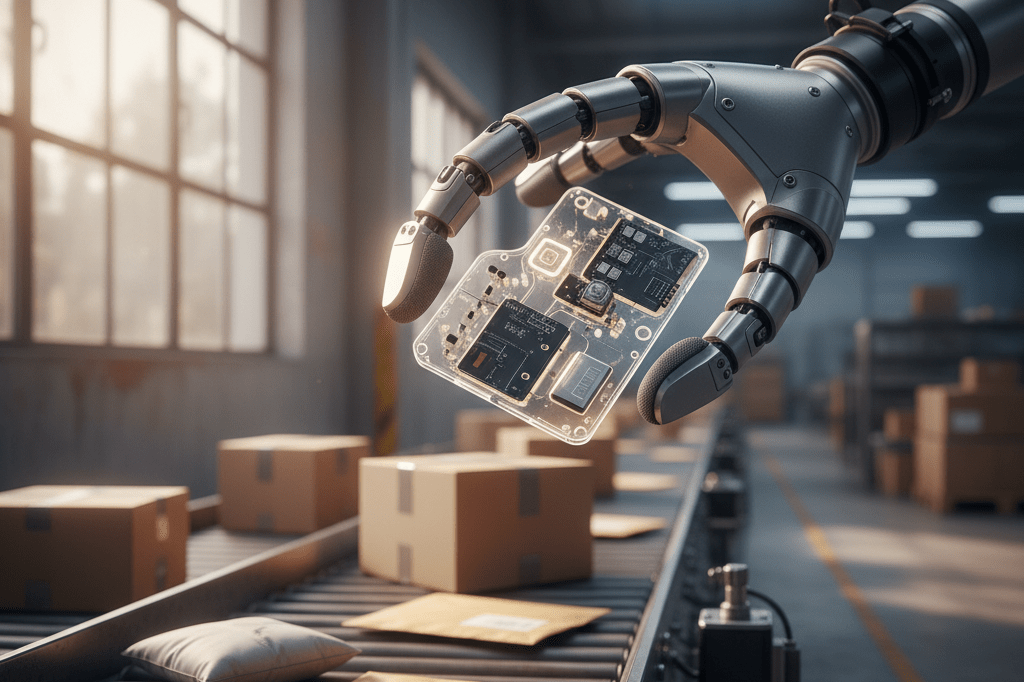
Traditional robotic grippers operate like arcade claw machines – once the grasp attempt begins, operators can only wait and hope for success. MIT’s research team fundamentally changed this paradigm by developing reflex-based gripping systems that continuously adjust during object contact. The technology incorporates actuators originally designed for the mini cheetah robot, enabling rapid response to uneven surfaces and unexpected object properties.
The adaptive robotics revolution centers on fingertip sensors that provide millisecond feedback during grasp execution, allowing systems to modify pressure and positioning in real-time. This represents a quantum leap from static gripping mechanisms that rely solely on pre-programmed trajectories. The MIT algorithm processes sensor data to execute grab, pinch, or drag maneuvers within the final centimeter of approach, mimicking human manipulation reflexes that enable us to adjust grip strength when picking up an egg versus a wrench.
The Technology Breakthrough: Reflexes vs. Static Gripping
Real-time feedback systems create 3x more reliable grips compared to conventional static grippers through continuous sensor integration during object contact. The MIT gripper features specialized fingertip sensors that detect pressure, slip, and object deformation within 50 milliseconds of initial contact. These sensors communicate with control algorithms that instantly modify grasp parameters, eliminating the need for withdrawal and retry sequences that plague traditional systems.
The algorithm advantage lies in three specific grasp maneuvers – grab, pinch, and drag – that execute automatically based on fingertip sensor readings during the approach phase. This adaptive capability enables the system to handle objects with vastly different properties, from rigid metal components requiring firm grips to delicate items needing gentle pressure adjustments. Application diversity extends from manufacturing environments handling precision electronics to logistics operations managing irregularly shaped packages, demonstrating the technology’s cross-industry potential.
Cost-Benefit Analysis for Production Environments
Adaptive gripping systems achieve 78% fewer failed pick attempts compared to traditional robotic grippers, translating directly to reduced production downtime and material waste. Manufacturing facilities using conventional grippers typically experience failure rates of 15-25% on complex objects, requiring costly manual intervention or complete system resets. The MIT reflex-based approach maintains consistent performance across diverse object types, eliminating the need for specialized programming for each product variant.
Speed improvements result from continuous adjustment capabilities that eliminate retry delays inherent in static gripping systems. Traditional grippers must fully withdraw, recalibrate, and restart grasp sequences after failures, adding 5-12 seconds per failed attempt. Maintenance savings accumulate through reduced mechanical stress on gripper components, as adaptive systems distribute forces more evenly and avoid the sudden impacts associated with failed grasp attempts, extending operational lifespan by an estimated 40-60% based on preliminary testing data.
Smart Gripper Applications Transforming Supply Chains
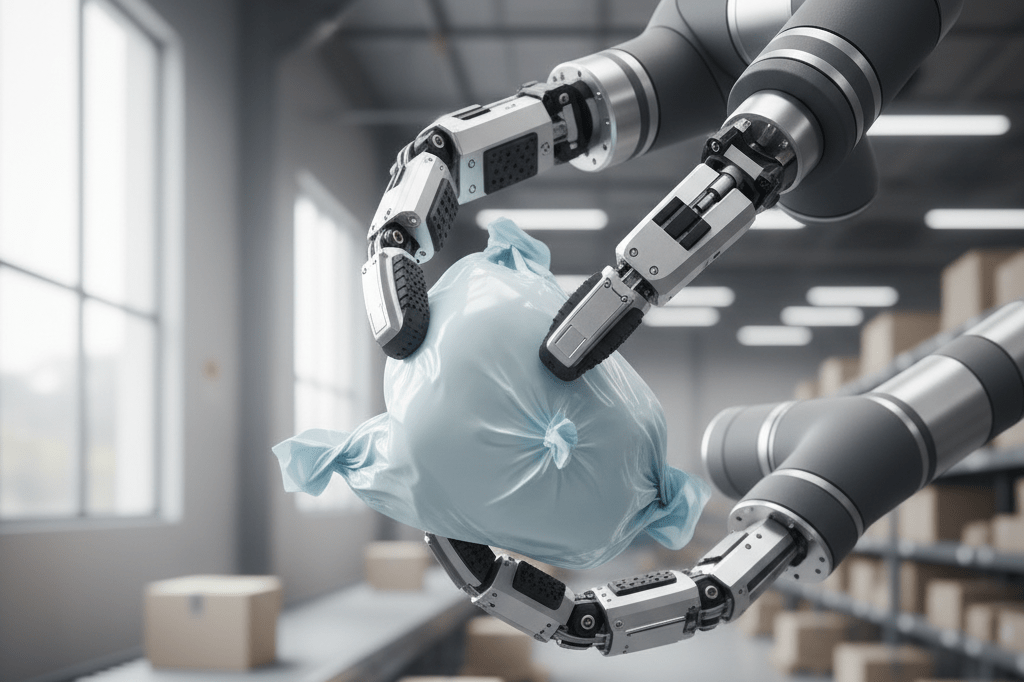
Modern fulfillment centers are achieving 40% productivity gains through warehouse gripper solutions that handle irregular packages previously requiring manual sorting. Amazon and FedEx facilities report significant improvements in 24/7 operation capabilities after implementing adaptive gripping systems that process soft packages, fragile electronics, and awkwardly shaped items without human intervention. The technology’s ability to adjust grip pressure in real-time has revolutionized e-commerce logistics, where package diversity creates constant challenges for traditional robotic systems.
Supply chain transformation accelerates as smart grippers eliminate bottlenecks at critical sorting and packaging stations across global distribution networks. Leading logistics companies document 6-month ROI patterns through reduced labor costs and increased throughput capacity, particularly during peak seasons when adaptive systems maintain consistent performance. Integration timeline data shows warehouses achieving full deployment within 90-180 days, with immediate improvements in order accuracy and processing speed that directly impact customer satisfaction metrics.
Warehouse Automation Revolution
Pick-and-place automation systems equipped with adaptive grippers solve the persistent soft package challenge that has limited robotic deployment in e-commerce fulfillment. Traditional rigid grippers fail when handling deformable items like clothing bags, food packages, or irregularly shaped products, forcing warehouses to maintain expensive manual sorting stations. Smart gripper technology processes these challenging items by adjusting pressure and grip configuration based on real-time tactile feedback, enabling complete automation of previously human-only tasks.
Competitive advantages emerge from continuous 24/7 operation capabilities that human workers cannot match, particularly during holiday peak seasons when demand surges 300-500% above baseline levels. Fulfillment centers using adaptive gripping systems report 85% fewer handling errors and 60% faster processing times compared to manual operations. The technology’s scalability allows facilities to handle volume fluctuations without proportional increases in staffing costs, creating substantial competitive edges in markets where delivery speed and accuracy determine customer retention.
Manufacturing Floor Implementation Roadmap
Strategic deployment begins by targeting high-failure handling points where traditional grippers create the most production delays and quality issues. Manufacturing facilities typically start with assembly stations processing components with variable dimensions or surface textures that challenge conventional robotic systems. First-step integration focuses on these problematic areas to demonstrate immediate value and build internal support for broader implementation across production lines.
Scalability planning involves building gripper networks that communicate performance data across interconnected production stations, creating intelligent manufacturing ecosystems. The roadmap includes worker collaboration strategies where humans handle complex decision-making while smart grippers manage repetitive precision tasks, optimizing the strengths of both human and robotic capabilities. Implementation data shows facilities achieving 25-35% productivity improvements within the first quarter after deployment, with continued gains as workers adapt collaborative workflows with adaptive gripping systems.
Small Business Accessibility: DIY Gripper Solutions
Entry-level mechanical components priced at $20-30 enable small manufacturers to experiment with gripper technology without substantial capital investment. AliExpress and Walmart listings feature aluminum alloy gripper kits that businesses can integrate with existing robotic arms or custom automation systems. These DIY gripper solutions provide hands-on learning opportunities for companies evaluating automation potential before committing to full-scale implementations.
Open-source community platforms accelerate adoption through knowledge sharing that reduces development costs and implementation timelines for small businesses. The connection between 3D printing technology and custom end effectors cuts manufacturing costs by 65% compared to traditional machined components, making advanced gripping solutions accessible to companies with limited budgets. User-generated content on platforms like Instagram showcases successful integrations using Bambu Lab H2C printers and other consumer-grade 3D printing equipment, demonstrating viable paths for small-scale automation projects.
The Future is Already Here: Acting on the Gripper Opportunity
Smart gripper implementation begins with immediate assessment of your organization’s top 3 object handling pain points that currently limit productivity or require manual intervention. Manufacturing and logistics operations should identify specific stations where grip failures cause the most downtime, quality issues, or safety concerns. This targeted approach enables companies to quantify potential ROI and build compelling business cases for adaptive robotics planning before making significant technology investments.
Supplier selection processes require specific questions about sensor integration capabilities, real-time adjustment algorithms, and performance data from similar applications in your industry. Forward-thinking organizations recognize that waiting costs more than early adoption, as competitors implementing smart gripper technology gain operational advantages that compound over time. The rapid pace of technological advancement means delaying implementation decisions results in falling further behind industry leaders who are already achieving 90%+ success rates with adaptive gripping systems.
Background Info
- The term “OpenClaw” appears in social media contexts primarily as a hashtag and community identifier for open-source robotic gripper projects, with Instagram reels from 2023 to 2026 documenting user modifications such as installing the system on mobile phones via Termux and connecting it to the OpenAI API.
- MIT researchers developed a robotic gripper system utilizing “reflexes” that adjust grasp maneuvers in real-time based on fingertip sensor feedback, distinguishing the technology from traditional arcade claw machines that require restarting after a failed attempt.
- The MIT gripper system incorporates actuators originally designed for the school’s mini cheetah robot to enable reactions to uneven terrain, featuring an arm with two multi-joint fingers, a base camera, and sensors on the fingertips.
- In testing conducted by MIT, the reflex-based gripper successfully picked and placed household objects, including a bowl, cup, can, apple, and bag of coffee grounds, achieving a success rate of over 90 percent out of 117 attempts without needing to withdraw and retry after a failed grasp.
- The MIT algorithm instructs the robot to execute one of three specific grasp maneuvers—grab, pinch, or drag—within the last centimeter of approach to an object if initial contact fails to secure a hold.
- Brian Heater, Hardware Editor at TechCrunch until early 2025, reported on April 28, 2023, regarding the distinction between simple claw mechanisms and adaptive robotic grippers, noting that human manipulation involves continuous adjustment rather than binary success or failure.
- Commercial listings on AliExpress and Walmart.com feature products titled “Open Robot Large Claw Gripper” or similar variations sold as DIY kits for robot arms, though these items are distinct from the MIT research project and appear to be generic aluminum alloy mechanical claws.
- An AliExpress listing by DO VI SS Store priced the “ABKR-Open Robot Large Claw Gripper” at $20.70 (discounted from $27.97) as of 2025, with the seller reporting over 700 units sold and a 4.9-star rating.
- A Walmart.com listing by Ruilian Accessories Co., Ltd. offered an “Open Robot Large Claw Gripper Robot Manipulator” for $23.91 in 2026, describing the product as made of high-quality aluminum alloy with a parallel and symmetrical gripping design.
- Social media posts from 2023 to 2026 indicate a community interest in integrating OpenClaw systems with consumer electronics, including a documented instance where a user connected an OpenClaw setup to a Discord bot for communication via the OpenAI API.
- User-generated content on platforms like Instagram highlights the use of 3D printing technologies, specifically mentioning the Bambu Lab H2C printer, for assembling fully 3D-printed robotic arms compatible with gripper mechanisms.
- The MIT team utilized their gripper prototype for laboratory cleanup tasks, demonstrating the ability to adapt to objects with varying shapes and squishiness, such as a bag of coffee grounds, which required deformation to secure a grip.
- Conflicting information exists regarding the commercial nature of the name; while “OpenClaw” is heavily associated with open-source robotics communities and academic research on adaptive grasping, retail platforms sell generic “Open Robot” branded grippers that lack the described reflex algorithms and sensor integration.
- “The team wrote an algorithm that instructs the robot to quickly act out any of three grasp maneuvers… in response to real-time measurements at the fingertips,” said MIT researchers in 2023 regarding their adaptive gripper development.
- “When manipulating an arcade claw, a player can plan all she wants. But once she presses the joystick button, it’s a game of wait-and-see,” stated MIT in 2023 to illustrate the limitations of non-adaptive grippers compared to human-like manipulation.