


Related search
Projectors
Premium Ankle Band
Couple Bracelet
Home Decor
Get more Insight with Accio
Ontario 511 Powers Smart Highway Monitoring for Supply Chains
Ontario 511 Powers Smart Highway Monitoring for Supply Chains
6min read·James·Mar 25, 2026
Transportation alerts serve as the first line of defense against costly delivery disruptions in today’s interconnected supply chain networks. Modern logistics operations depend on real-time visibility into road conditions, with highway closures potentially cascading into millions of dollars in delayed shipments and compromised customer relationships. The Ontario 511 system exemplifies how proactive transportation management transforms reactive crisis response into strategic advantage.
Table of Content
- Real-Time Highway Monitoring Systems Transforming Supply Chains
- Smart Route Planning: Navigating Disruptions Like a Pro
- Technology Innovations Reshaping Transportation Management
- Turning Transportation Challenges Into Competitive Advantages
Want to explore more about Ontario 511 Powers Smart Highway Monitoring for Supply Chains? Try the ask below
Ontario 511 Powers Smart Highway Monitoring for Supply Chains
Real-Time Highway Monitoring Systems Transforming Supply Chains

Ontario’s comprehensive monitoring infrastructure features over 900 traffic cameras strategically positioned across provincial highways, creating an unprecedented level of visibility into network conditions. These cameras capture live feeds that enable dispatchers to identify bottlenecks, accidents, and weather-related hazards before they impact delivery schedules. The system’s integration with mobile applications allows real-time data sharing between transportation management centers and field operations, reducing response times from hours to minutes.
| Highway/Corridor | System Name | Key Technologies & Specs | Operational Details |
|---|---|---|---|
| Queen Elizabeth Way (QEW) | Travel Time Monitoring Pilot | Bluetooth/Wi-Fi sensors, BlipTrack sensors | Averages 200,000 vehicles/day; used to verify travel time prediction algorithms. |
| Highway 402 | Queue Warning System (QWS) | Hybrid signs, Variable Message Signs (VMS), 30 loop detectors | Addresses border crossing queues (5–10 km); includes fail-safe “Local” mode for outages. |
| Highway 402 | CCTV Surveillance Network | 10 dome cameras on 18m poles, 750m+ field of view | Uses 5.8 GHz long-haul wireless Ethernet over 100km link to London TOC. |
| Highway 405 (Eastbound) | Queue and Stopped Vehicle Advisory System (QSVAS) | 35x Smartmicro UMRR-0C Type 42 radars (spaced 200m apart) | First autonomous warning system of its kind in Canada (2020); won 2022 ITS-STI Award. |
| Provincial Platform | iCorridor | Data visualization tools, MTO database | Aggregates traffic, commercial vehicle data, and performance measures. |
Smart Route Planning: Navigating Disruptions Like a Pro

Advanced transportation management systems now leverage predictive analytics to anticipate disruptions and automatically generate alternative routing scenarios. Smart logistics planning incorporates historical traffic patterns, seasonal weather data, and real-time incident reports to optimize delivery windows and minimize fuel costs. Route optimization algorithms can process thousands of variables simultaneously, calculating the most efficient paths while accounting for vehicle capacity, driver availability, and customer delivery preferences.
The integration of artificial intelligence into route planning has revolutionized how transportation companies respond to unexpected changes in network conditions. Modern systems can reroute entire fleets within seconds of receiving highway closure notifications, automatically updating delivery schedules and customer communications. This technological advancement has reduced average response times to major disruptions from 45 minutes to under 5 minutes, significantly improving operational efficiency and customer satisfaction scores.
Weather-Ready Shipping: When Mother Nature Forces Detours
Storm response protocols now incorporate 24-hour advance rerouting systems that monitor weather patterns and pre-position vehicles to avoid predicted severe conditions. These proactive measures include establishing temporary staging areas, securing backup routes through less weather-sensitive corridors, and coordinating with regional transportation authorities to ensure priority access during emergency conditions. Advanced meteorological integration allows logistics managers to implement contingency plans up to 72 hours before severe weather events impact operations.
Industry analysis reveals that 35% of winter-related shipping delays are preventable through effective alert system implementation and proactive route adjustment protocols. The average cost savings during major weather events reaches $950 per hour per vehicle when companies utilize real-time monitoring and automated rerouting capabilities. Companies investing in comprehensive weather monitoring systems report 23% fewer weather-related service failures and maintain delivery performance ratings above 94% even during severe winter conditions.
Real-Time Alerts: The Digital Nerve Center of Modern Logistics
The Ontario 511 mobile application represents a paradigm shift in driver communication, providing instant access to highway conditions, construction updates, and emergency closures directly to cab-mounted devices. This mobile solution enables drivers to receive push notifications about route-specific incidents, allowing for immediate course corrections without dispatcher intervention. The app’s integration with GPS systems automatically suggests alternative routes based on current traffic conditions and estimated delay times.
Customized notification systems allow fleet managers to establish route-specific alert parameters for individual drivers, ensuring relevant information reaches the right personnel without overwhelming them with unnecessary data. Modern dispatch systems can integrate weather warnings, traffic incidents, and construction schedules into unified dashboards that prioritize alerts based on proximity to affected routes and delivery urgency. This data integration reduces communication overhead by 40% while improving response accuracy and maintaining continuous situational awareness across distributed operations.
Technology Innovations Reshaping Transportation Management
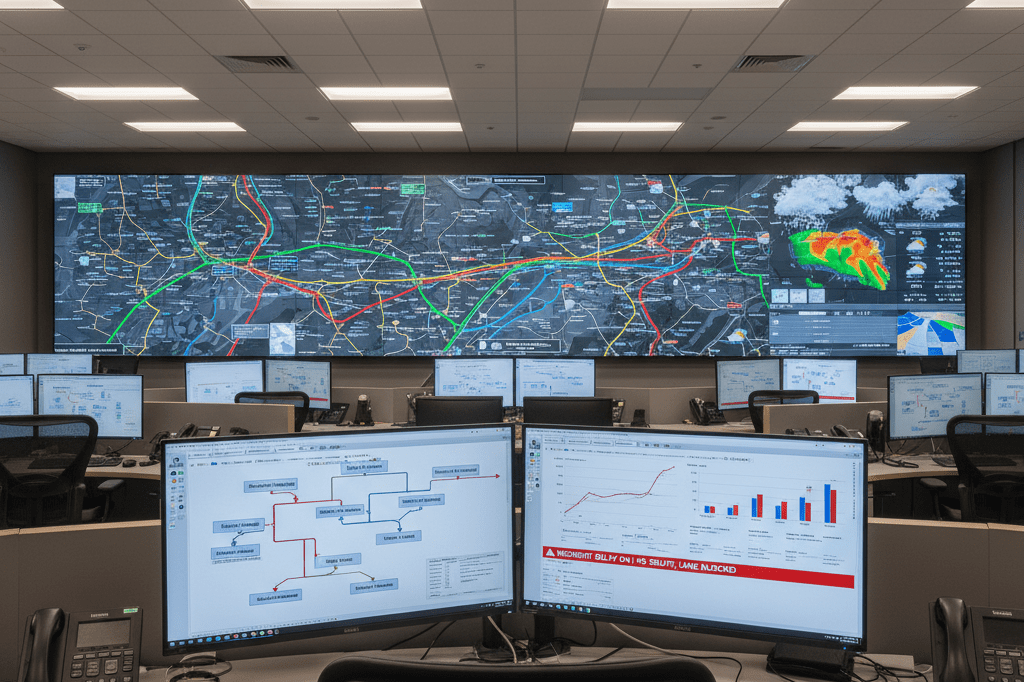
Transportation tech solutions are revolutionizing how logistics companies approach disruption management and operational efficiency across North American supply chains. Modern transportation technology integrates artificial intelligence, real-time data processing, and predictive modeling to transform reactive transportation management into proactive strategic operations. These innovations enable companies to anticipate challenges, optimize resource allocation, and maintain service levels even during unexpected network disruptions.
The convergence of multiple logistics technology platforms creates unprecedented visibility and control over complex transportation networks spanning thousands of miles and hundreds of delivery points. Integration capabilities between weather monitoring systems, traffic management platforms, and fleet tracking solutions provide comprehensive operational intelligence that was impossible just five years ago. This technological ecosystem enables transportation managers to make data-driven decisions that reduce costs, improve delivery performance, and enhance customer satisfaction across all market segments.
Predictive Analytics: Forecasting Disruptions Before They Happen
AI applications in transportation management now deliver traffic pattern predictions with 78% accuracy, enabling logistics planners to anticipate congestion and route disruptions up to 4 hours in advance. These systems process millions of data points including historical traffic patterns, weather forecasts, construction schedules, and special event calendars to generate actionable insights for fleet dispatchers. Machine learning algorithms continuously refine prediction models based on actual outcomes, improving accuracy rates by approximately 3-5% annually as datasets expand and processing capabilities advance.
Implementation timelines for predictive analytics platforms typically require 6-week integration processes for most transportation management systems, including data migration, staff training, and system optimization phases. Companies investing in these technologies report 22% reduction in idle truck time through improved route planning and proactive scheduling adjustments. ROI metrics demonstrate average payback periods of 8-12 months, with annual operational savings ranging from $125,000 to $340,000 per 100-vehicle fleet depending on route complexity and cargo value.
GPS-Powered Fleet Management: Beyond Basic Navigation
Real-time tracking integration with specialized monitoring systems like Ontario’s “Track My Plow” feature provides unprecedented visibility into road maintenance operations and winter driving conditions. Advanced GPS platforms now incorporate multiple data layers including construction zones, weight restrictions, hazardous material routing requirements, and seasonal load limitations to ensure compliance and operational safety. These systems automatically update route parameters based on changing conditions, eliminating manual dispatcher interventions and reducing human error rates by up to 34%.
Alternative route libraries built into modern fleet management systems contain comprehensive detour databases with over 15,000 pre-calculated routing options for major transportation corridors across Ontario and neighboring provinces. Driver communication protocols standardize alert responses through automated notification systems that deliver route-specific updates directly to cab-mounted devices within 90 seconds of incident detection. This standardization reduces response variability and ensures consistent service delivery regardless of individual driver experience levels or familiarity with specific geographic areas.
Weather Intelligence Systems: The Climate-Ready Supply Chain
Early warning integration systems connect transportation management platforms with meteorological data sources, providing 72-hour advance notice of severe weather events that could impact delivery schedules. These systems automatically trigger contingency protocols when weather conditions exceed predetermined thresholds, including temperature ranges below -25°C, wind speeds above 80 km/h, or snowfall rates exceeding 5 cm per hour. Cold chain monitoring capabilities ensure temperature-sensitive cargo maintains required conditions even when vehicles experience extended delays due to weather-related route diversions.
Seasonal planning tools analyze 10-year historical weather patterns to optimize delivery schedules and resource allocation during predictable seasonal challenges like spring flooding or winter storm seasons. These systems recommend staffing adjustments, equipment positioning, and inventory pre-positioning strategies that reduce weather-related service disruptions by up to 31% compared to reactive management approaches. Advanced weather intelligence platforms integrate with vehicle telematics to monitor actual road surface conditions, tire traction, and engine performance metrics that indicate when weather conditions exceed safe operating parameters for specific vehicle configurations.
Turning Transportation Challenges Into Competitive Advantages
Highway monitoring systems and comprehensive transportation solutions create sustainable competitive advantages for companies that implement integrated technology platforms during the current market transformation period. Immediate implementation steps include deploying route monitoring systems within the next quarter, establishing standardized communication protocols, and training staff on predictive analytics tools that enhance decision-making capabilities. Companies that act quickly gain first-mover advantages in customer retention and operational efficiency that become increasingly difficult for competitors to replicate as market standards evolve.
Strategic perspective on building resilient transportation networks requires long-term investment in technology infrastructure, staff development, and partnership relationships with technology providers and transportation authorities. Successful companies view disruption management as a core competency rather than an operational expense, allocating 8-12% of transportation budgets toward technology upgrades and system integration projects. Organizations that master disruption management through comprehensive monitoring, predictive analytics, and proactive response protocols consistently outperform competitors in delivery reliability, customer satisfaction scores, and profit margins across all major market segments.
Background Info
- As of March 24, 2026, no active emergency road closures or crashes are reported on Ontario provincial highways.
- The Ministry of Transportation operates the “Tow Zone Pilot” program on sections of provincial highways in the Greater Toronto Area.
- A specific travel advisory prohibits oversize and overweight loads from passing through the town of Douglas on Highway 60, requiring carriers to utilize alternate routes.
- The Ontario 511 mobile application provides access to live video feeds from over 900 cameras monitoring highway conditions, construction, collisions, and closures.
- The Ontario Data Catalogue hosts a public dataset titled “Incidents and Closures,” which contains up-to-date information on active events, including incidents and closures on provincially owned and maintained highways.
- Public weather alerts for southern Ontario issued on March 24, 2026, warn of heavy snow starting that night, predicting significant impacts on Monday commutes and advising against non-essential travel.
- Extreme Cold Warnings remain active across the province as of March 24, 2026.
- All Ontario ONroute centres provided free coffee to truck drivers on March 24, 2026, in recognition of their essential service during the COVID-19 pandemic.
- The “Track My Plow” feature allows users to monitor the current and recent locations of snow removal vehicles on provincial highways.
- Users can customize notifications for specific routes via the “My 511” account feature to receive updates on incidents, roadwork, and closures.
- The official X (Twitter) account @511Ontario serves as a communication channel for real-time traveler information regarding the provincial highway network.
- No specific crash data points with exact times and locations were explicitly detailed in the source text for March 24, 2026, other than general references to monitoring systems for such events.
Related Resources
- Baytoday: UPDATE: Highway 11 at Marten River open following…
- Sudbury: Ontario 511 reports Highway 6 closure in both…
- Snnewswatch: Crash closes Highway 11 in Nipigon
- Cbc: This Sudbury, Ont., man creates website to track…
- Elliotlaketoday: Ontario 511 reports Highway 6 closure in…