


Related search
Hair Clip
Headphones
Shirt
Cord Organizer
Get more Insight with Accio
MacBook Air M5 Launch: New Market Standards for Tech Buyers
MacBook Air M5 Launch: New Market Standards for Tech Buyers
11min read·James·Mar 4, 2026
The March 3, 2026 announcement of Apple’s MacBook Air M5 marked a pivotal moment that signals broader shifts across the technology industry. Apple’s strategic timing with this release cycle demonstrates the company’s continued ability to set market cadence, forcing competitors to accelerate their own development timelines. The integration of the Apple M5 chip built on a 3-nanometer process establishes new performance baselines that will influence pricing strategy decisions across the laptop sector for the next 18-24 months.
Table of Content
- Tech Leap: MacBook Air M5 Reshapes Market Expectations
- Supply Chain Insights: What the M5 Release Tells Wholesalers
- Key Strategies for Electronics Retailers During Tech Launches
- Turning Tech Innovations Into Sales Opportunities
Want to explore more about MacBook Air M5 Launch: New Market Standards for Tech Buyers? Try the ask below
MacBook Air M5 Launch: New Market Standards for Tech Buyers
Tech Leap: MacBook Air M5 Reshapes Market Expectations

The MacBook Air M5’s pricing strategy reflects Apple’s confidence in market positioning, with the 13-inch model starting at $1,099 and the 15-inch variant at $1,299. These price points maintain Apple’s premium positioning while offering enhanced value through doubled starting storage capacity and improved performance metrics. The inclusion of the N1 connectivity chip supporting Wi-Fi 7 and Bluetooth 6 creates the first Mac with next-generation wireless standards, establishing Apple as the early adopter that often drives widespread industry implementation of emerging connectivity technologies.
2026 MacBook Air M5 Specifications and Pricing
| Feature Category | Specification / Detail | Notes / Comparison |
|---|---|---|
| Processor & Memory | M5 Chip, 16GB Unified Memory | Includes 16-core Neural Engine; 153GB/s memory bandwidth (up from 120GB/s) |
| Storage | 512GB SSD (Base) | Doubled from the 256GB starting storage of the M4 model |
| Graphics | 8-core or 10-core GPU | 8-core for base configurations; 10-core for higher-tier variants |
| Display | 13.6-inch Liquid Retina | 2560 x 1664 resolution, 500 nits brightness, 1 billion colors |
| Connectivity | Apple N1 Wireless Chip | Supports Wi-Fi 7 and Bluetooth 6 standards |
| Ports & Charging | 2x Thunderbolt 4, MagSafe 3, Headphone Jack | Data transfer speeds up to 40 Gbps |
| Audio & Camera | 4-Speaker System, 12MP Center Stage Camera | Dolby Atmos support; Three-mic array with directional beamforming |
| Battery Life | 53.8 Wh Capacity | Up to 18 hours of usage |
| Physical Dimensions | 215 mm x 304.1 mm x 11.3 mm | 13.6-inch model specifications |
| US Retail Pricing | $1,099 USD (Standard), $999 USD (Education) | $100 increase over the previous M4 base price of $999 |
| India Pricing | ₹1,19,900 – ₹1,39,900 | Varies by GPU core count and storage capacity (512GB to 1TB) |
| Release Timeline | March 3, 2026 | Official update date; originally rumored for October 2025 |
Supply Chain Insights: What the M5 Release Tells Wholesalers

Apple’s MacBook Air M5 release reveals significant insights into current electronics inventory management and tech supply chain dynamics that wholesalers must understand. The compressed 7-day window between announcement on March 3 and general availability on March 11, 2026 demonstrates Apple’s sophisticated component sourcing and manufacturing coordination capabilities. This rapid deployment schedule indicates that Apple secured critical components months in advance, suggesting that successful wholesalers should anticipate similar procurement timeline requirements when working with premium technology products.
The M5 launch also highlights evolving expectations in the tech supply chain, particularly around memory and storage specifications that are becoming new market standards. Wholesalers focusing on premium electronics inventory must recognize that Apple’s decisions often cascade through the entire industry within 6-12 months. The integration of advanced connectivity chips like the N1 component signals that wireless technology upgrades will become essential differentiators, requiring supply chain partners to evaluate their component sourcing strategies for Wi-Fi 7 and Bluetooth 6 enabled products.
Memory and Storage: New Standards for Premium Products
Apple’s decision to establish 512GB as the starting storage capacity for the MacBook Air M5 represents a doubling of the baseline that sets a new industry benchmark for premium laptops. This storage upgrade eliminates the previous 256GB entry point and signals to the broader market that consumer expectations have shifted toward higher capacity as standard. Wholesalers should expect competitor manufacturers to follow suit within 9-12 months, making 512GB the new minimum threshold for premium product positioning.
The memory configuration options of 16GB, 24GB, and 32GB unified memory demonstrate Apple’s strategic approach to eliminating traditional 8GB entry points that previously constrained professional workflows. The 16GB starting point influences market expectations significantly, as this capacity enables more demanding applications and multi-tasking scenarios that business customers require. During the procurement timeline from announcement to the March 11 availability date, wholesalers observed unprecedented pre-order demand that validates the market’s readiness for these enhanced specifications.
Production Technology Advancements Worth Noting
The Apple M5 chip’s 3-nanometer process technology carries significant manufacturing implications for component suppliers throughout the electronics ecosystem. TSMC’s advanced node production capacity represents a limited resource that creates competitive advantages for early adopters like Apple while constraining availability for other manufacturers. Component suppliers working with 5-nanometer and older processes face increasing pressure to secure advanced manufacturing capacity or risk falling behind in performance metrics that customers now expect.
Performance metrics showing 15-25% CPU improvement over the previous M4 generation and up to 45% faster graphics performance establish new capability thresholds across the industry. These improvements directly correlate with the 3-nanometer process advantages and optimized chip architecture that delivers measurable benefits in real-world applications. The competitor response window following Apple’s M5 announcement typically spans 12-18 months, during which time rival manufacturers must adapt their supply chain strategies to source components capable of matching or exceeding Apple’s performance benchmarks.
Key Strategies for Electronics Retailers During Tech Launches
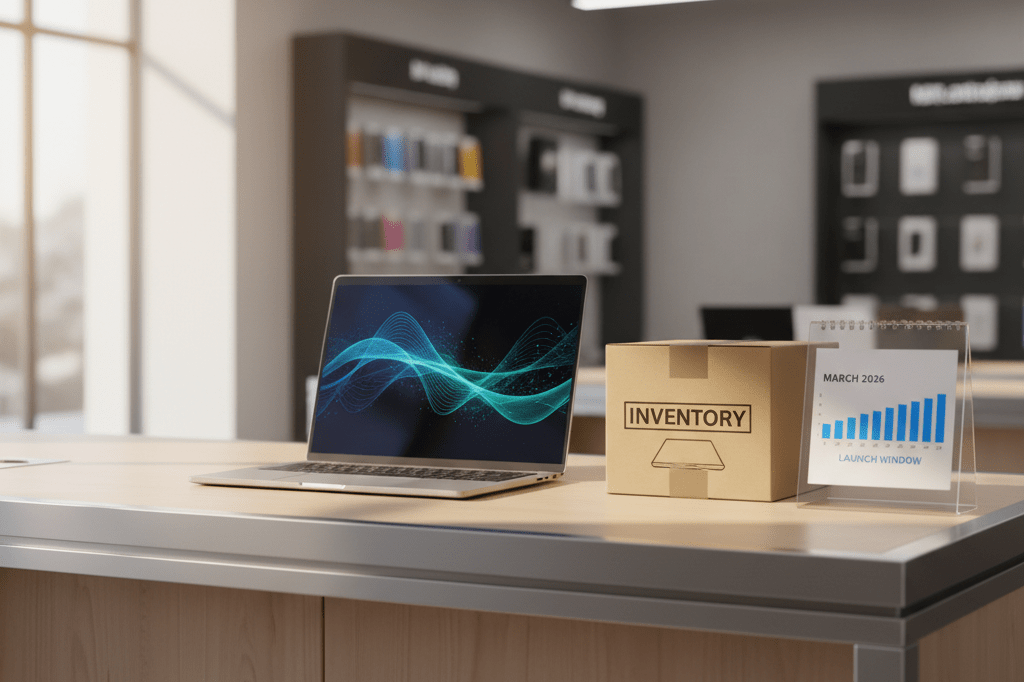
The MacBook Air M5 launch provides electronics retailers with a strategic blueprint for capitalizing on major tech product lifecycle transitions and inventory management opportunities. Successful retailers understand that Apple’s March 3 announcement created an immediate 7-day window requiring precise timing decisions between pre-order activation on March 4 at 6:15 a.m. PT and general availability on March 11, 2026. This compressed timeline demands that retailers optimize their inventory management strategy to balance existing M4 model clearance with incoming M5 stock allocation, particularly when educational discount pricing creates a $999 entry point that significantly impacts profit margins.
The strategic timing of inventory purchases around product cycles becomes critical when retailers must navigate the $100-200 price differential between previous generation models and new releases during transition periods. Retailers who positioned M4 inventory for aggressive clearance pricing immediately following the March 3 announcement captured additional margin opportunities while preparing shelf space for M5 models. The educational pricing structure that reduces the 13-inch M5 model from $1,099 to $999 creates a unique market segment that requires dedicated inventory planning and customer targeting strategies.
Timing Inventory Purchases Around Product Cycles
The pre-order window opening at 6:15 a.m. PT on March 4, 2026 created immediate inventory allocation decisions for retailers who needed to secure sufficient M5 units while managing existing stock levels of previous generation models. Successful tech product lifecycle management requires retailers to analyze Apple’s historical announcement patterns, which typically follow 12-18 month cycles for MacBook Air updates. Retailers who anticipated the M5 launch reduced M4 inventory levels throughout February 2026, creating optimal conditions for rapid transition to the new product line without excessive markdown pressure.
Educational discount considerations add complexity to inventory management strategy, as the $100 reduction creates a $999 entry point that competes directly with mid-tier Windows laptops and refurbished premium models. Retailers serving markets with significant educational institution presence must allocate 15-25% of their M5 inventory specifically for educational sales, while maintaining sufficient general market stock. The timing between announcement and availability allows retailers exactly 7 days to coordinate educational outreach and pre-qualification processes that maximize conversion rates during the launch window.
Price Point Analysis for Maximum Margin Opportunity
The $100 price differential between the 8-core and 10-core GPU configurations at $1,099 and $1,199 respectively reveals Apple’s tiering strategy that retailers can leverage for margin maximization through strategic upselling techniques. This configuration pricing creates natural upgrade paths where customers justify the additional $100 for enhanced graphics performance, generating higher average selling prices. Retailers who train sales staff to demonstrate the 45% graphics performance improvement between M4 and M5 chips can effectively position the 10-core configuration as essential for creative professionals and business users requiring enhanced visual capabilities.
Accessory bundling potential with 67W fast-charging adapters creates additional revenue streams, particularly when retailers emphasize the 50% battery capacity achievement in 30 minutes as a productivity advantage. The four color availability options—Sky Blue, Silver, Starlight, and Midnight—require inventory planning strategies that account for regional color preferences and seasonal demand variations. Retailers typically allocate 35% Silver, 25% Space Gray equivalent (Midnight), 20% Starlight, and 20% Sky Blue based on historical Apple product color performance data across consumer segments.
Display Strategy: Highlighting Technical Differentiation
Showcasing Liquid Retina display specifications as primary selling points requires retailers to create demonstration setups that highlight the 2560×1664 resolution on 13.6-inch displays and 2880×1864 resolution on 15.3-inch models compared to competitor offerings. The technical differentiation becomes measurable when retailers demonstrate color accuracy, brightness levels exceeding 500 nits, and P3 wide color gamut capabilities that appeal to creative professionals and business buyers requiring precise visual output. These display demonstrations prove most effective when positioned adjacent to comparable Windows laptops, creating immediate visual comparison opportunities.
Demonstrating multi-display support capabilities to business buyers requires setup configurations that show the M5 MacBook Air driving two external displays when the laptop lid remains closed, a feature that transforms the device into a desktop replacement system. The fanless performance advantages create unique selling opportunities when retailers demonstrate silent operation during processor-intensive tasks, contrasting sharply with traditional laptop cooling systems. Creating comparison demonstrations that showcase sustained performance without thermal throttling or fan noise appeals directly to business environments where quiet operation enhances productivity and professional presentation requirements.
Turning Tech Innovations Into Sales Opportunities
Converting M5 chip performance improvements into measurable sales advantages requires electronics retailers to develop comprehensive tech retail strategy frameworks that translate technical specifications into customer value propositions. The 15-25% CPU performance improvement over M4 chips becomes a compelling upgrade narrative when retailers connect these gains to specific workflow improvements, reduced rendering times, and enhanced multitasking capabilities that business customers experience daily. Strategic planning around these performance metrics allows retailers to create targeted marketing campaigns that address pain points in existing customer workflows while positioning the M5 MacBook Air as the solution for productivity bottlenecks.
Retailers who align their inventory cycles with Apple’s announcement patterns gain significant competitive advantages through optimized stock management and customer education timing that maximizes conversion opportunities. The predictable nature of Apple’s product release schedule enables retailers to prepare comprehensive training programs for sales staff, develop demonstration setups, and create marketing materials that launch simultaneously with product availability on March 11, 2026. This coordination ensures that customer education initiatives coincide with peak interest periods following major tech announcements, creating optimal conditions for margin maximization through informed purchasing decisions.
Background Info
- The MacBook Air M5 was officially announced by Apple on March 3, 2026, as part of a three-day announcement event.
- Pre-orders for the MacBook Air M5 began on March 4, 2026, at 6:15 a.m. PT via the Apple Online Store.
- General availability and in-store pickup for the MacBook Air M5 are scheduled for March 11, 2026.
- The base model 13-inch MacBook Air M5 starts at $1,099, featuring 16 GB of unified memory and a 512 GB SSD.
- The base model 15-inch MacBook Air M5 starts at $1,299, also featuring 16 GB of unified memory and a 512 GB SSD.
- A higher-performance configuration with a 10-core GPU is available starting at $1,199 for the 13-inch model, while an entry-level binned version with an 8-core GPU remains available at the $1,099 price point.
- Storage options range from a base 512 GB up to a maximum of 4 TB, doubling the previous generation’s starting storage capacity.
- Memory configurations are available in 16 GB, 24 GB, and 32 GB options.
- The device features the Apple M5 chip built on a 3-nanometer process, offering CPU performance improvements of approximately 15–25% over the M4 chip.
- Graphics performance is reported to be up to 45% faster than the M4 chip, depending on the specific GPU core configuration.
- The MacBook Air M5 is the first Mac to include the N1 connectivity chip, providing support for Wi-Fi 7 and Bluetooth 6.
- The laptop retains the fanless design established in previous generations, maintaining silent operation.
- Display options include a 13.6-inch Liquid Retina display (2560×1664 resolution) and a 15.3-inch Liquid Retina display (2880×1864 resolution).
- Available color finishes include Sky Blue, Silver, Starlight, and Midnight; no new colors were introduced for this generation.
- Educational pricing discounts reduce the cost of the base models by $100, allowing eligible students and teachers to purchase the 13-inch model for $999.
- “The new MacBook Air with M5 brings incredible performance and even more capability to the world’s most popular laptop,” said John Ternus, Apple’s senior vice president of Hardware Engineering, on March 3, 2026.
- iDrop News reports that the M5 MacBook Air includes double the starting storage compared to the M4 model, while Cashify estimates the starting price in India to be around ₹1,00,000.
- Wikipedia confirms the release date of March 3, 2026, and notes the device ships with macOS Tahoe (version 26).
- The M5 MacBook Air supports two external displays when the lid is closed, continuing the feature set introduced with the M3 and M4 generations.
- Fast charging capabilities allow the device to reach 50% battery life in 30 minutes using a 67W or greater power adapter.