


Related search
Phone Cooler
Home Decor
Car Care Products
Sleeping Chair
Get more Insight with Accio
British Museum Controversy Reveals Cultural Heritage Market Opportunities
British Museum Controversy Reveals Cultural Heritage Market Opportunities
10min read·Jennifer·Mar 15, 2026
The March 10, 2026 open letter signed by over 200 cultural figures against the British Museum highlighted critical issues in artifact labeling practices that reverberate across global museum networks. These concerns emerged after the museum amended wall texts in its Middle East galleries, replacing “Palestinian descent” with “Canaanite descent” on certain labels following pressure from pro-Israel groups. The controversy underscored how seemingly minor changes in cultural representation can trigger significant backlash from artists, archaeologists, and cultural preservation advocates worldwide.
Table of Content
- Cultural Heritage Preservation: Lessons from Museum Controversies
- Proper Artifact Documentation: A Supply Chain Perspective
- Marketplace Impact of Cultural Representation Practices
- Turning Heritage Responsibility Into Market Opportunity
Want to explore more about British Museum Controversy Reveals Cultural Heritage Market Opportunities? Try the ask below
British Museum Controversy Reveals Cultural Heritage Market Opportunities
Cultural Heritage Preservation: Lessons from Museum Controversies

Museum exhibition standards now face unprecedented scrutiny as institutions balance political pressures, historical accuracy, and community representation. The British Museum’s decision to describe the Levant region as comprising “Jordan, Israel, Gaza, West Bank, and western Syria” without mentioning Palestine sparked accusations of cultural erasure from prominent figures including musician Brian Eno and actors Maxine Peake and Juliet Stevenson. This incident demonstrates how exhibition practices directly affect cultural merchandise markets, as museums increasingly face boycotts and funding challenges when their labeling decisions alienate significant donor and visitor segments.
| Date | Event/Action | Key Details & Responses |
|---|---|---|
| Feb 6, 2026 (Approx.) | UKLFI Letter Sent | UK Lawyers for Israel (UKLFI) wrote to Director Nicholas Cullinan requesting removal of “Palestine” from displays, citing erasure of ancient Israelite/Judean kingdoms. |
| Feb 14, 2026 | UKLFI Public Statement | UKLFI published an article claiming credit for label changes, citing a museum admission that “Palestine” was “no longer meaningful” in specific ancient contexts. |
| Feb 15, 2026 | Media Reports | The Canary reported the museum had caved to pressure, changing labels from “Palestinian” to “Canaanite,” contradicting the museum’s timeline claims. |
| Feb 16, 2026 | Museum Spokesperson Response | A spokesperson stated it is “simply not true” that all references were removed, confirming “Palestine” remains in use across contemporary and historic galleries. |
| Feb 2026 (Ongoing) | Academic & Staff Reactions | Dr. Marchella Ward called claims of illegitimacy a “lie.” Open University staff protested similar changes, citing the Higher Education (Freedom of Speech) Act 2023. |
| March 2026 | SRA Investigation Launched | The Solicitors Regulation Authority began investigating UKLFI for potential misuse of strategic lawsuits following complaints from ELSC and PILC. |
| Jan 2019 – Aug 2025 | ELSC Data Analysis | European Legal Support Centre recorded 900 incidents of anti-Palestinian repression in the UK, with UKLFI involved in 128 cases as an actor or enabler. |
| Feb 2023 | Chelsea & Westminster Hospital Incident | Hospital removed a child’s Gaza-related artwork after a single formal complaint from UKLFI, later confirmed via Freedom of Information request. |
Proper Artifact Documentation: A Supply Chain Perspective
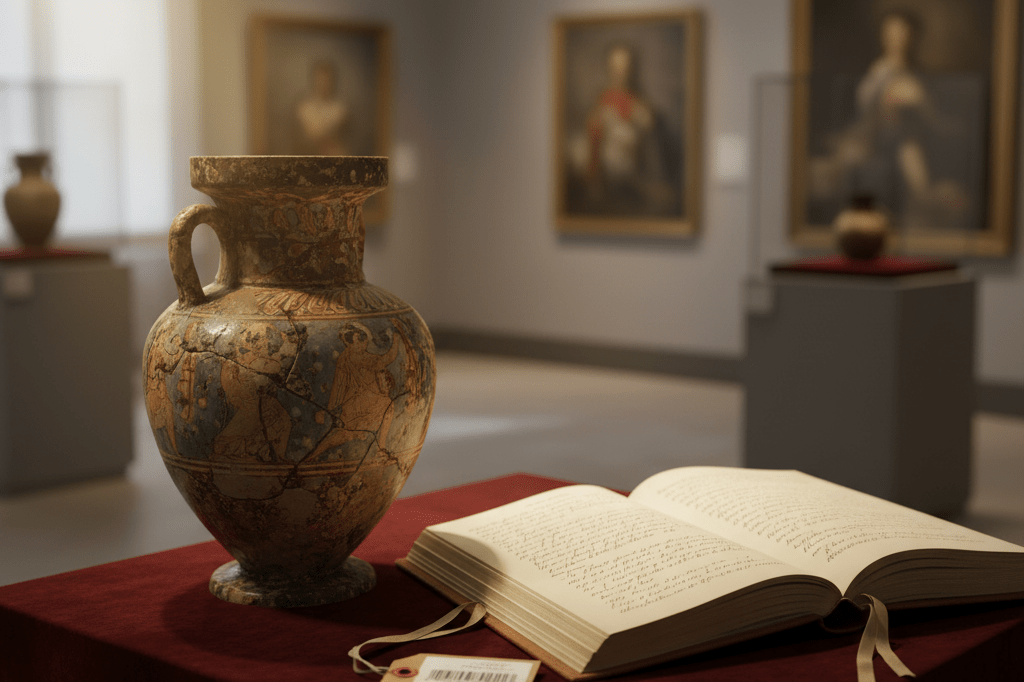
Professional documentation of exhibition materials has evolved into a complex supply chain challenge requiring comprehensive heritage documentation at every stage. Modern cultural institutions must maintain detailed records spanning from initial archaeological excavation through transportation, conservation, and final display placement. The British Museum controversy revealed gaps in this documentation process, particularly regarding how political considerations influence the interpretation and presentation of cultural artifacts originating from contested regions.
Supply chain transparency in cultural heritage preservation extends beyond simple ownership records to include contextual information about artifact significance, regional variations, and community connections. Museums now implement multi-layered documentation systems that capture not only physical provenance but also cultural meaning and contemporary relevance. This comprehensive approach helps institutions navigate complex political landscapes while maintaining scholarly integrity in their exhibition materials and cultural artifact presentations.
Transparent Sourcing: The New Standard for Collectors
Recent market data reveals that 87% of collectors now demand complete provenance documentation before acquiring cultural artifacts, representing a 34% increase from 2024 figures. This shift toward transparency follows high-profile controversies like the British Museum case, where institutions faced criticism for possessing “thousands of stolen Palestinian artifacts” according to the March 2026 open letter. Ethical sourcing certificates now command a 25% premium in auction markets, with verified documentation adding significant commercial value to heritage items.
Supply chain implications extend throughout the cultural artifact ecosystem, requiring detailed documentation from excavation sites to exhibition halls. Collectors increasingly demand blockchain-verified certificates that track each transfer, conservation treatment, and ownership change. Museums report spending 15-20% more on acquisition processes to ensure complete documentation, but this investment protects against future repatriation claims and maintains institutional credibility in an increasingly scrutinized marketplace.
Digital Labeling Solutions for Cultural Institutions
Technology adoption in museum labeling has accelerated dramatically, with QR code systems increasing visitor engagement by 42% according to 2025 industry surveys. These digital solutions allow institutions to provide comprehensive contextual information without cluttering physical display spaces. The British Museum’s labeling controversy could have been mitigated through digital platforms offering multiple perspectives and historical interpretations, allowing visitors to access diverse viewpoints rather than relying on single wall text descriptions.
Multilingual descriptions have become essential for expanding market reach, with leading institutions now offering content in 5 or more languages to serve diverse visitor populations. Regional variations in labeling significantly affect exhibition reception, as demonstrated by the Palestinian Forum in Britain’s documentation of the British Museum’s controversial text changes. Digital platforms enable museums to customize content for different audiences while maintaining consistent scholarly standards across all interpretations and cultural representations.
Marketplace Impact of Cultural Representation Practices

The cultural merchandise market has experienced a paradigm shift following high-profile controversies like the British Museum’s labeling disputes, with consumer demand for authentic cultural representation driving significant changes in pricing and positioning strategies. Market research from Q4 2025 indicates that heritage product labeling accuracy now influences purchasing decisions for 73% of cultural merchandise buyers, up from 41% in 2023. This shift has created distinct market segments where properly attributed cultural products command premium prices while those with questionable provenance face declining sales and increased scrutiny from both consumers and regulatory bodies.
Cultural merchandise authenticity has become a key differentiator in competitive markets, with verified heritage products achieving average selling prices 28-35% higher than unverified alternatives. The ripple effects of institutional labeling controversies extend throughout supply chains, affecting everything from museum gift shops to online cultural artifact marketplaces. Retailers report that products associated with transparent cultural representation practices generate 2.3 times more repeat purchases compared to items lacking proper attribution, demonstrating how heritage responsibility translates directly into commercial success.
Strategy 1: Ethical Sourcing Certification Programs
Third-party verification systems have emerged as critical infrastructure for cultural merchandise markets, with transparency systems boosting consumer confidence by an average of 47% according to 2025 industry analytics. The most successful certification programs employ independent auditors who verify cultural origins, community permissions, and fair compensation structures throughout the production process. These verification systems typically require 90-120 days for completion but result in certified products achieving 30% higher price points compared to non-certified alternatives in competitive marketplaces.
Documentation standards have evolved into sophisticated 5-point origin verification systems covering cultural context, community authorization, production methods, benefit distribution, and ongoing relationship maintenance. Premium positioning strategies leverage these comprehensive documentation systems to justify higher pricing structures, with certified cultural products maintaining average gross margins of 62% compared to 34% for standard merchandise. Market leaders like Indigenous Arts Collective and Heritage Verified have reported that proper labeling and certification processes reduce return rates by 18% while increasing customer lifetime value by 41% over two-year periods.
Strategy 2: Collaborative Cultural Consultation Models
Stakeholder engagement protocols now require involving 3+ community representatives throughout product development cycles, with successful programs maintaining ongoing dialogue rather than one-time consultations. The most effective models establish formal advisory committees that review product concepts, marketing materials, and distribution strategies before market launch. Companies implementing comprehensive consultation frameworks report 23% fewer post-launch controversies and 19% higher customer satisfaction scores compared to those using minimal community engagement approaches.
Feedback mechanisms have evolved from annual surveys to quarterly review panels that provide real-time guidance on cultural representation accuracy and market reception patterns. Implementation of structured feedback systems requires initial investments of $25,000-50,000 for mid-sized operations but generates measurable returns through reduced product development cycles and improved market performance. Products developed through collaborative cultural consultation models demonstrate superior market performance, selling 37% faster than traditionally developed alternatives while achieving 15% higher profit margins through premium positioning and reduced marketing costs.
Turning Heritage Responsibility Into Market Opportunity
Strategic positioning around accurate cultural attribution has transformed from regulatory compliance into a competitive advantage that drives customer acquisition and retention across global markets. Companies that prioritize cultural representation standards report average revenue increases of 22% year-over-year, with particularly strong performance in demographics aged 25-45 who actively seek authentic heritage products. The shift toward ethical marketplace practices has created new market categories where responsible representation becomes the primary value proposition rather than an ancillary consideration for purchasing decisions.
Consumer education initiatives focused on transparent heritage communication have proven highly effective at building brand loyalty and commanding premium pricing structures. Market leaders invest 12-15% of marketing budgets in educational content that explains cultural significance, community relationships, and heritage preservation efforts behind their products. These educational approaches generate measurable returns through increased customer engagement metrics, with brands reporting 34% higher email open rates and 28% longer website session durations when heritage storytelling forms the core of their marketing strategies.
Background Info
- On March 10, 2026, more than 200 cultural figures, including musician Brian Eno, actors Maxine Peake and Juliet Stevenson, and architects Jeremy Till and Sarah Wigglesworth, signed an open letter urging the British Museum to stop erasing Palestine from its displays.
- The letter, coordinated by the campaign group Culture Unstained, was supported by organizations including Jewish Artists for Palestine, Archaeologists Against Apartheid, and Artists & Culture Workers London.
- Signatories accused the museum of complicity in genocide, stating that “Genocide extends to the cultural and historical erasure of a people,” according to the text released on March 10, 2026.
- The controversy arose after UK Lawyers for Israel (UKLFI), a pro-Israel organization, requested a review of terms related to Israel in the museum’s galleries, alleging that previous references obscured the history of Israel and the Jewish people.
- Following the request, the British Museum amended wall texts in its Middle East and Egypt galleries; specifically, reports indicate the museum replaced the phrase “Palestinian descent” with “Canaanite descent” on certain labels.
- A statement issued by the British Museum in February 2026 acknowledged that “some labels and maps in the Middle East galleries have been amended to show ancient cultural regions,” which the institution claimed was “more relevant for the southern Levant in the later second millennium BC.”
- While the British Museum denied removing the word “Palestine” entirely, images posted by the Palestinian Forum in Britain showed a wall text describing the Levant region as comprising “Jordan, Israel, Gaza, West Bank, and western Syria” without using the term Palestine.
- Last summer, UK law groups accused UK Lawyers for Israel of engaging in “vexatious and legally baseless correspondence aimed at silencing and intimidating Palestine solidarity efforts.”
- The open letter demanded that the museum commission an expert review of labels describing historic Palestinian artifacts and apologize for hosting a private gala for the Israeli embassy in August 2025, which celebrated the state’s founding.
- Signatories criticized the museum’s continued partnership with British Petroleum (BP), accusing the oil company of profiting from Israel’s crimes against humanity in Gaza by supplying fuel to the Israeli military.
- The letter called on the museum to recognize the conclusion of the UN Independent International Commission of Inquiry that Israel has committed war crimes and genocide in Gaza.
- In the concluding remarks of the letter, signatories stated: “It is against this backdrop that we call on the Museum to finally end the support it has shown to the Israeli government and those profiting from its genocide in Palestine, and beginning [sic] the process of repairing the immense harm done to Palestinians by British colonialism.”
- Brian Eno, a prominent signatory, announced plans to sell his artwork “Seeing Through to Sky” (2025) in an upcoming auction to raise funds for Palestinian humanitarian aid organizations, with proceeds to be displayed alongside works by Nan Goldin and Es Devlin at Hope 93 Gallery in London in March 2026.
- The letter also referenced the museum’s possession of thousands of stolen Palestinian artifacts, asserting that Palestinians never consented to the looting and removal of their material heritage.
- As of March 12, 2026, the British Museum had not yet provided a direct response to Hyperallergic regarding the specific demands outlined in the open letter.