


Related search
Women Shirt
Wedding Ring
Headphones
Home Decor
Get more Insight with Accio
5000 Year Old Chinese Tomb Reveals Ancient Trading Secrets
5000 Year Old Chinese Tomb Reveals Ancient Trading Secrets
7min read·Jennifer·Mar 27, 2026
The discovery of a 5000-year-old tomb at the Wangzhuang ruins in Henan Province has unveiled remarkable insights into China’s earliest commercial networks. This royal burial site, designated M27 and covering over 17 square meters, contained more than 350 artifacts that demonstrate sophisticated trading relationships dating back to approximately 3000 BCE. The tomb’s impressive dimensions of 4.52 to 4.8 meters in length reveal the wealth accumulated through prehistoric commerce during the Dawenkou Culture period.
Table of Content
- Ancient Chinese Trading Traditions Revealed Through Royal Tomb
- Luxury Goods Market Lessons from 5000-Year-Old Artifacts
- Strategic Insights from Ancient Trade for Modern Merchants
- Timeless Market Principles Unearthed in Henan Province
Want to explore more about 5000 Year Old Chinese Tomb Reveals Ancient Trading Secrets? Try the ask below
5000 Year Old Chinese Tomb Reveals Ancient Trading Secrets
Ancient Chinese Trading Traditions Revealed Through Royal Tomb
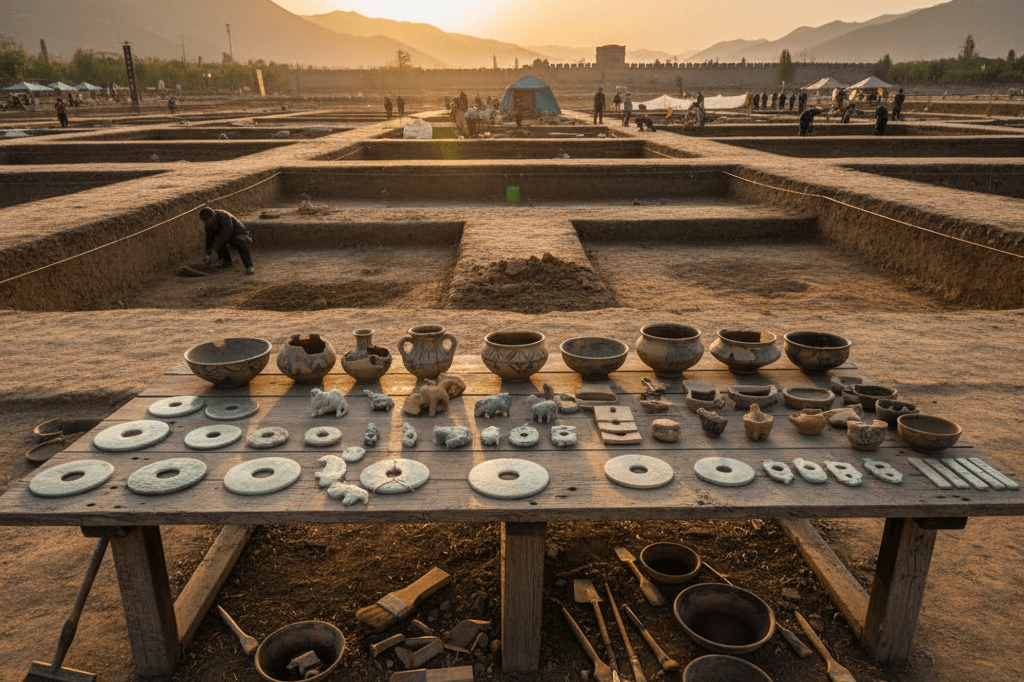
Archaeological evidence from this Chinese prehistoric commerce hub indicates that ancient trade artifacts moved across vast distances through established networks. The Dawenkou Culture, which flourished from 4000 BCE to 2600 BCE, developed trading relationships spanning multiple regions across ancient China. Excavations conducted jointly by the Henan Provincial Institute of Cultural Heritage and Archaeology and Capital Normal University since 2023 have revealed that over 1,000 burial artifacts were unearthed from the entire Wangzhuang site in 2024 alone, with 45 new tombs discovered that year.
Key Findings at the Wangzhuang Ruins
| Category | Details | Significance |
|---|---|---|
| Site Location & Era | Henan Province, Central China; Late Neolithic (approx. 5,000 years ago) | Potential prehistoric capital of the Dawenkou Culture |
| Tomb Dimensions | Over 17 square meters in area | Indicates immense power and high status for the interred individual |
| Recovered Artifacts | 350+ items including jade ornaments, bone tools, ceremonial pottery, and pig mandibles | Evidence of cultural exchange and ritualistic demonstration of wealth |
| Skeletal Remains | Incomplete; only a few toe bones discovered | Suggests deliberate desecration or looting shortly after burial |
| Condition of Tomb | Scattered jade pieces and broken ceremonial weapons found | Points to violent conflict or politically motivated destruction |
| Historical Impact | Discovery reported July 29, 2025, as “rewriting the narrative” | Redefines understanding of early statehood and social stratification in East Asia |
Luxury Goods Market Lessons from 5000-Year-Old Artifacts
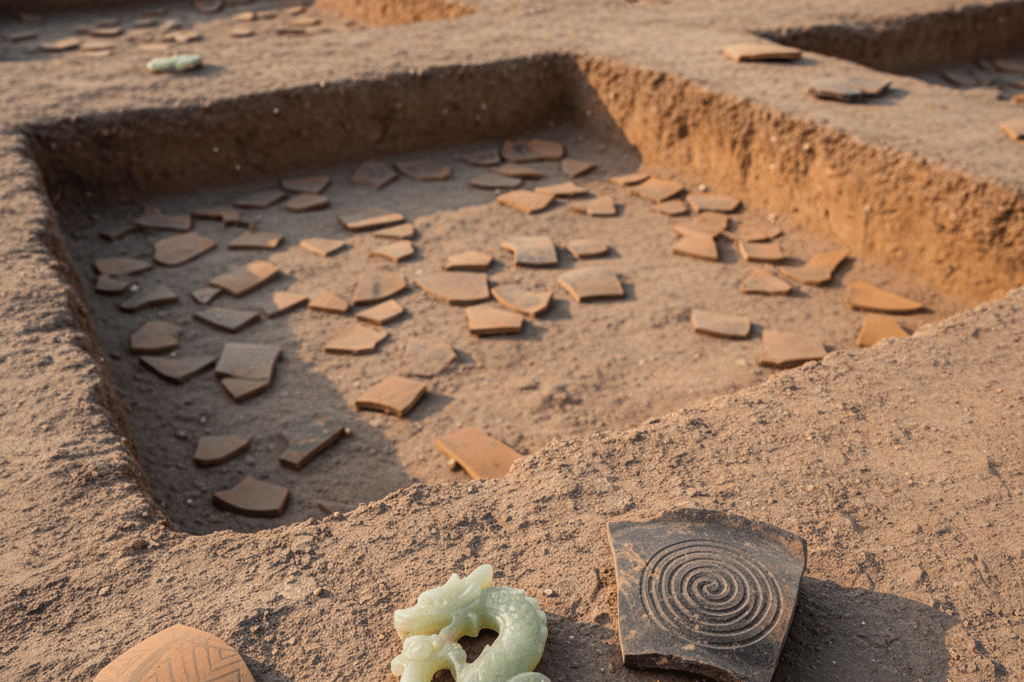
The M27 tomb’s artifact collection provides unprecedented insights into ancient luxury goods distribution and market hierarchies. Nearly 200 small jade ornaments, over 100 pottery pieces, and numerous ceremonial objects demonstrate how premium materials established social status 5,000 years ago. The correlation between tomb size and burial object richness, as noted by archaeological team leader Liu Haiwang, reveals clear evidence of class stratification and economic differentiation in prehistoric Chinese society.
These cultural exchange goods traveled through sophisticated supply chains that connected distant regions across ancient China. The presence of both local Dawenkou artifacts and imported items from contemporary cultures indicates a complex market system where ceremonial artifacts served as both status symbols and trade commodities. The deliberate destruction of the tomb shortly after burial, evidenced by scattered jade ornaments and broken stone ceremonial blades, suggests these luxury items held significant economic and symbolic value worth targeting by ancient raiders.
3 Premium Materials That Defined Ancient Status
Jade commerce dominated the luxury goods market of prehistoric China, with nearly 200 jade ornaments recovered from the M27 tomb alone. These included the earliest known gui ceremonial jade tablet and a jade burial mask that pushes the timeline for this ornament type back by 2,000 years, as reported by Sixth Tone in October 2024. The sophisticated craftsmanship and variety of jade pieces demonstrate established trade networks that brought raw materials from distant sources to skilled artisans in the Dawenkou region.
Pottery trade networks reveal extensive regional exchange systems through over 100 ceramic pieces found within the royal burial. The discovery of small-mouthed pointed-bottom jars and small-mouthed shouldered jars typical of the contemporaneous Yangshao culture indicates cross-cultural commercial relationships. Stone ritual blades served as ceremonial objects market indicators, with their deliberate destruction after the tomb’s looting suggesting these items represented significant economic value and political power within ancient Chinese society.
Cross-Cultural Exchange Evidence in Ancient China
Archaeological evidence reveals trading partnerships with four major regional cultures: the Liangzhu culture of the lower Yangtze River, the Qujialing culture of the middle Yangtze, the Yangshao culture, and the Hongshan culture of the Liao basin. These connections demonstrate how goods traveled over 1000 miles through prehistoric China’s supply chain routes. Li Xinwei, deputy director of the Institute of Ancient History at the Chinese Academy of Social Sciences, noted on October 16, 2024, that these discoveries provide evidence for the diversity and initial exchanges of early Chinese civilization.
The distinction between imported versus local production becomes clear through careful analysis of artifact origin markers. Customs observed at the M27 tomb, including the burial of water deer teeth and the presence of deformed occipital bones, align closely with eastern Dawenkou Culture traditions while incorporating elements from distant trading partners. The 630,000 square meter Wangzhuang settlement served as a prehistoric kingdom capital, facilitating these extensive commercial networks that would take researchers more than a decade to fully excavate and understand.
Strategic Insights from Ancient Trade for Modern Merchants
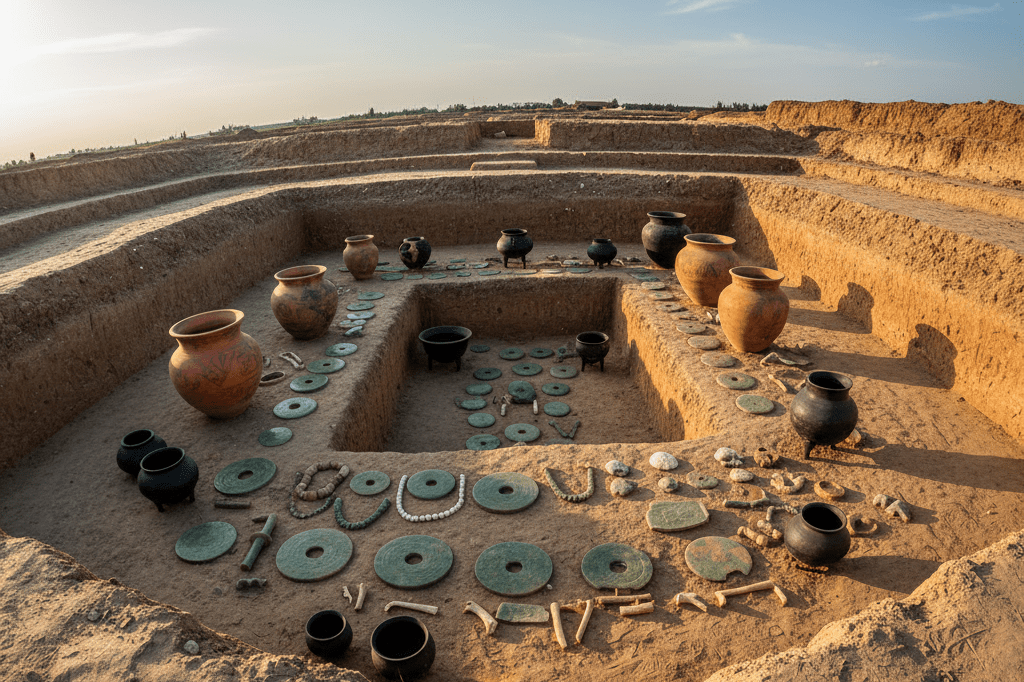
The 5000-year-old royal tomb at Wangzhuang ruins offers invaluable strategic lessons for contemporary luxury goods merchants and high-end retailers. Archaeological analysis of the M27 tomb’s 350+ artifacts reveals sophisticated marketing strategies that created exclusivity through controlled distribution channels and premium positioning. The tomb’s evidence of deliberate artifact scattering and targeted looting demonstrates how ancient luxury items achieved such high perceived value that they became targets for organized raids, indicating successful brand positioning millennia before modern marketing concepts existed.
Modern merchants can extract actionable insights from the Dawenkou Culture’s approach to product differentiation and market segmentation. The clear correlation between tomb size and burial object richness, documented by archaeological team leader Liu Haiwang, mirrors contemporary luxury market hierarchies where product tiers reflect consumer status levels. These prehistoric commerce strategies achieved brand recognition across multiple cultures, with Dawenkou luxury goods found in settlements spanning over 1000 miles of ancient China’s trading networks.
Exclusivity as Selling Strategy: The Royal Tomb Lesson
The jade burial mask discovered in tomb M27 represents one of history’s most effective examples of exclusivity marketing, pushing the timeline for this luxury ornament type back by 2,000 years according to Sixth Tone’s October 2024 report. This ceremonial artifact served as the ultimate status symbol, reserved exclusively for royal burials and creating aspirational value among the elite classes of prehistoric Chinese society. The mask’s intricate craftsmanship and rare materials established a luxury brand identity that transcended regional boundaries, with similar designs appearing in trading partner cultures across ancient China.
Evidence from the 630,000 square meter Wangzhuang settlement indicates tightly controlled distribution channels that maintained product exclusivity through geographic and social barriers. The nearly 200 small jade ornaments found within the M27 tomb demonstrate graduated luxury tiers, with the most elaborate pieces reserved for the highest social ranks. Design evolution analysis across the 1400-year span of Dawenkou Culture (4000 BCE to 2600 BCE) reveals systematic refinements in craftsmanship and material selection, showing how ancient artisans continuously innovated to maintain their luxury market position against emerging competitors.
Product Authentication in Ancient vs. Modern Markets
Ancient Dawenkou artisans developed sophisticated authentication methods that rival modern anti-counterfeiting techniques, embedding unique craftsmanship signatures into luxury jade items and ceremonial pottery. Archaeological analysis of over 100 pottery pieces from tomb M27 reveals consistent firing techniques, clay composition patterns, and decorative motifs that served as authenticity markers for discerning buyers. These prehistoric quality control measures included specific jade carving techniques, standardized ceremonial blade proportions, and distinctive pottery glazing methods that regional specialists could verify through visual inspection.
The three primary hallmarks of authentic Dawenkou goods include distinctive jade working techniques evidenced in the earliest known gui ceremonial tablet, specialized pottery firing methods creating characteristic surface textures, and standardized proportional relationships in ceremonial stone blade construction. Regional specialization created natural authentication barriers, with specific quarry sources for jade materials and localized clay deposits producing unique mineral signatures in finished products. Quality verification systems included ritualistic burial practices such as water deer teeth placement and specific bone positioning patterns that authenticated both the artifacts and their ceremonial contexts within Dawenkou cultural traditions.
Timeless Market Principles Unearthed in Henan Province
The Wangzhuang archaeological site demonstrates three fundamental market principles that remain relevant for modern business strategy: cultural exchange drives innovation, luxury goods transcend temporal boundaries, and extensive trade networks build lasting civilizations. Evidence from the 45 newly discovered tombs in 2024 shows how interaction between the Dawenkou Culture and contemporary civilizations like the Yangshao, Liangzhu, Qujialing, and Hongshan cultures sparked continuous product innovation and design evolution. The presence of mixed artifact styles within individual burial sites indicates that successful ancient merchants actively sought foreign influences to differentiate their offerings and capture emerging market segments.
Li Xinwei from the Chinese Academy of Social Sciences noted on October 16, 2024, that these discoveries provide concrete evidence for the diversity and initial exchanges that shaped early Chinese civilization through commercial activity. The 1,000+ burial artifacts recovered from Wangzhuang in 2024 alone demonstrate how premium materials like jade, specialized pottery, and ceremonial stone items maintained their luxury appeal across multiple generations and cultural transitions. Associate Professor Zhu Guanghua’s identification of Wangzhuang as a prehistoric kingdom capital rather than an ordinary settlement underscores how successful trade networks created the economic foundation necessary for complex political structures and urban development in ancient China.
Background Info
- A tomb dating to approximately 5,000 years ago (c. 3000 BCE) was discovered at the Wangzhuang ruins in Yongcheng city, Henan Province, central China, with excavation reports published between October 14 and October 24, 2024.
- The site belongs to the middle and late periods of the Dawenkou Culture, which existed from 4000 BCE to 2600 BCE during the late Neolithic Age.
- The specific royal tomb, designated M27 by Archaeology News Online Magazine, covers an area of over 17 square meters, measuring between 4.52 to 4.8 meters in length and 3.47 to 3.68 meters in width.
- Experts from the Henan Provincial Institute of Cultural Heritage and Archaeology, Capital Normal University, and other institutions have conducted joint excavations at the site since 2023.
- Over 350 artifacts were unearthed from the M27 tomb alone, including more than 100 pieces of pottery, nearly 200 small jade ornaments, bone tools, and animal remains such as pig mandibles symbolizing wealth.
- More than 1,000 burial artifacts, including pottery and jade items, were unearthed from the entire Wangzhuang ruins in 2024.
- In 2024, a total of 45 new tombs of the Dawenkou Culture were discovered at the Wangzhuang ruins, with 27 of them fully excavated.
- The tomb features both inner and outer wooden coffins, but the skeletal remains of the owner are largely missing, with only a few toe bones remaining.
- Evidence indicates the tomb suffered deliberate destruction shortly after burial, characterized by looted artifacts, scattered jade ornaments inside and outside the coffin, and deliberately broken stone ceremonial blades.
- “The latest discovery indicates that the Wangzhuang ruins are not an ordinary settlement, but rather the capital of a prehistoric kingdom,” said Zhu Guanghua, associate professor at Capital Normal University, on October 16, 2024.
- Customs observed at the tomb, such as the burial of water deer teeth and the presence of deformed occipital bones, align closely with eastern Dawenkou Culture traditions.
- Artifacts typical of the contemporaneous Yangshao culture, including small-mouthed pointed-bottom jars and small-mouthed shouldered jars, were also found, indicating cultural interplay between the two traditions.
- Sixth Tone reported on October 17, 2024, that the tomb contained a jade burial mask pushing the timeline for this ornament type back by 2,000 years, as well as the earliest known gui, a ceremonial jade tablet.
- Findings suggest trade and cultural exchange with the Liangzhu culture of the lower Yangtze River, the Qujialing culture of the middle Yangtze, and the Hongshan culture of the Liao basin.
- “Its discoveries testify to the initial exchanges of early Chinese civilization, providing evidence for the nature of diversity of the Chinese civilization,” said Li Xinwei, deputy director of the Institute of Ancient History at the Chinese Academy of Social Sciences, on October 16, 2024.
- Liu Haiwang, leader of the joint archaeological team, stated that the richness of burial objects correlates with tomb size, indicating clear social hierarchy and class stratification had emerged by this period.
- Some sources indicate the Wangzhuang settlement covers a total area of at least 630,000 square meters, while the excavated portion remains a fraction of the whole.
- Excavations began in March 2024 after villagers initially discovered jade, bones, and pottery while refurbishing a pond.
- Researchers estimate the full excavation and study of the site could take more than a decade.
- The site provides the first evidence of reburial practices within the Dawenkou culture, where later generations reopened graves to bury new individuals alongside original occupants.
Related Resources
- Thetravel: 350 Artifacts From 5,000-Year-Old Tomb Of…
- Popularmechanics: Archaeologists Found a 5,000-Year-Old…
- Colombiaone: Ancient Royal Tomb Found in China Dates Back 5…
- Chinadaily: Excavation unearths 5,000-year-old royal tomb…
- Sixthtone: Stunning Tomb Find Sheds New Light on…